

Lecture Series Unpacked: Design Thinking and Operational Art in Military Organizations
A series where I present slide-by-slide several popular presentations I have conducted over the last decade (plus) for multiple War Colleges and Universities around the globe

Hey Substack friends- here is a new series where I will break down entire presentations that I have done over the years to a wide variety of military and academic audiences. Frequently, I am invited to engage with seminars or entire colleges to talk about design, complexity science, innovation in warfare, conflict philosophy, and more recently, on the intersection of AI/ML and war, quantum and future warfare, the expansion of the space domain, and how some fusion of space, cyberspace, and special operations in asymmetric warfare might be significant to the coming decades. What I intend to do is post all the slides for a presentation inside one of these articles (this will be LOOONNNGGG- I usually speak for 90 minutes and can cram much of this into an hour if necessary) with the slide notes and other information, sources, links. The intent here is to foster greater awareness of the theories, doctrines, methodologies, and various arguments afoot in contemporary security affairs and the military community of practice. There are around 28 slides with slide notes below!
If you like this particular slide deck below, consider checking out a digital or paperback version of my first book ( based on my doctoral thesis), ‘Understanding the Military Design Movement: War, Change, and Innovation’, (Routledge 2023) available at Amazon and if you have university library access, available digitally through Taylor & Francis for most school programs (including separate chapters!). Link to book is here: https://www.amazon.com/Understanding-Military-Movement-Routledge-Technology/dp/103248179X/ref=tmm_pap_swatch_0
Okay, let’s dive into this presentation. On this one, I have presented this at the U.S. Marine Corps’ War College in Quantico for several years, at Yale University (a wonderful visit back to CT, my home state!), to the Canadian Forces College’s war college cohort in Toronto several times, to the Australian Command and Staff College in Canberra, the Johns Hopkins’ US Space Force advanced military program, and to the National Defense University (NDU) Eisenhower School in Washington D.C. among numerous other entities and programs. This presentation is a broad overview of my ‘Understanding the Military Design Movement’ with each chapter represented here- starting with the origins of ‘design thinking’ and the clear linkages for both commercial (civilian design methods) and subsequent military variations (not directly descended from, oddly) dating back to the Interwar Period between the First and Second World Wars. Let’s begin, shall we (a nod to those RLM fans out there):
First slide:
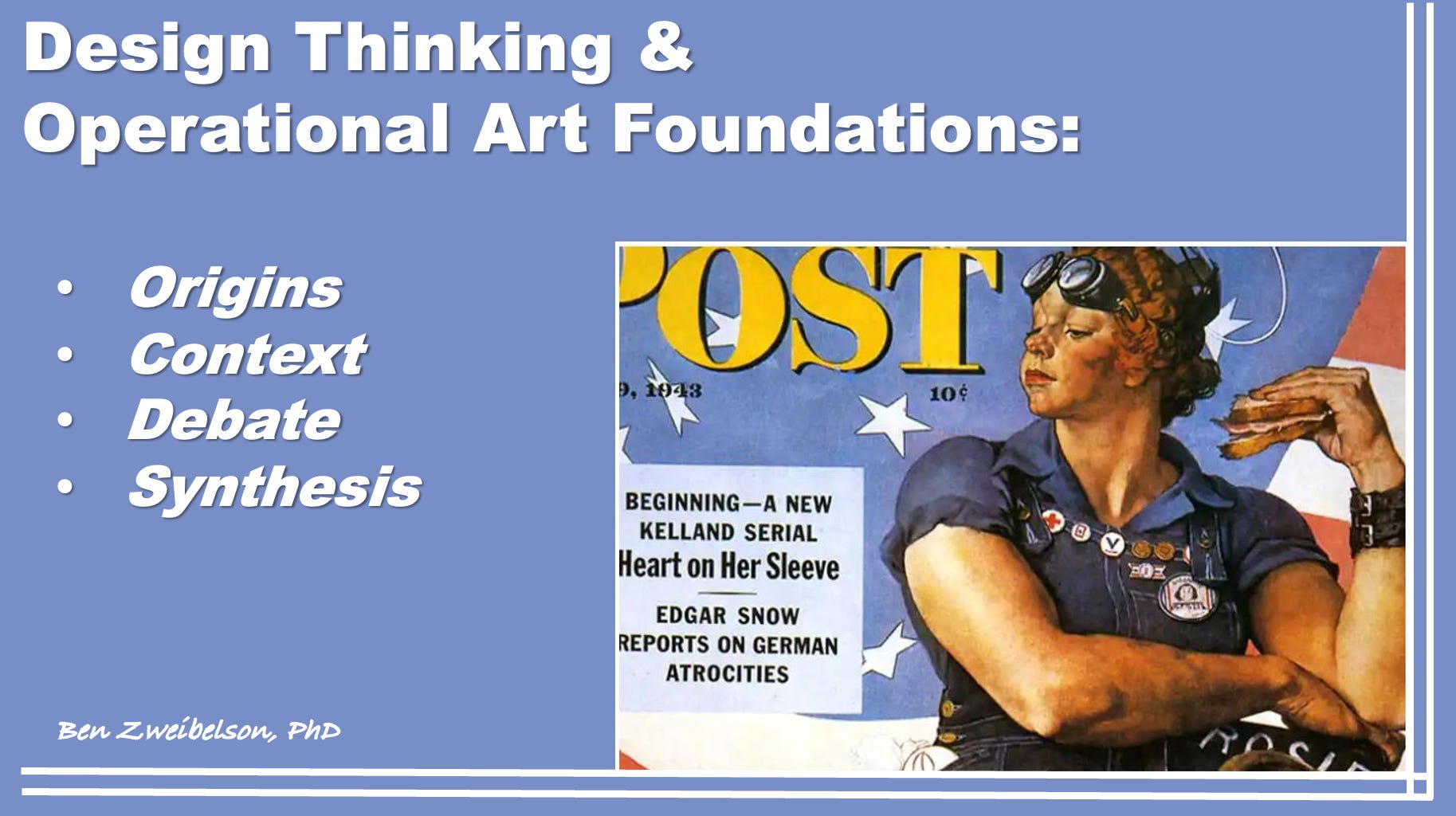
Sets the tone and I intentionally led with the classic ‘Rosy the Riveter’ artwork to draw attention back to the early twentieth century and the significant transformation societies were undergoing (to include the most industrialized, horrific and destructive wars ever witnessed by humanity).
Slide 2:
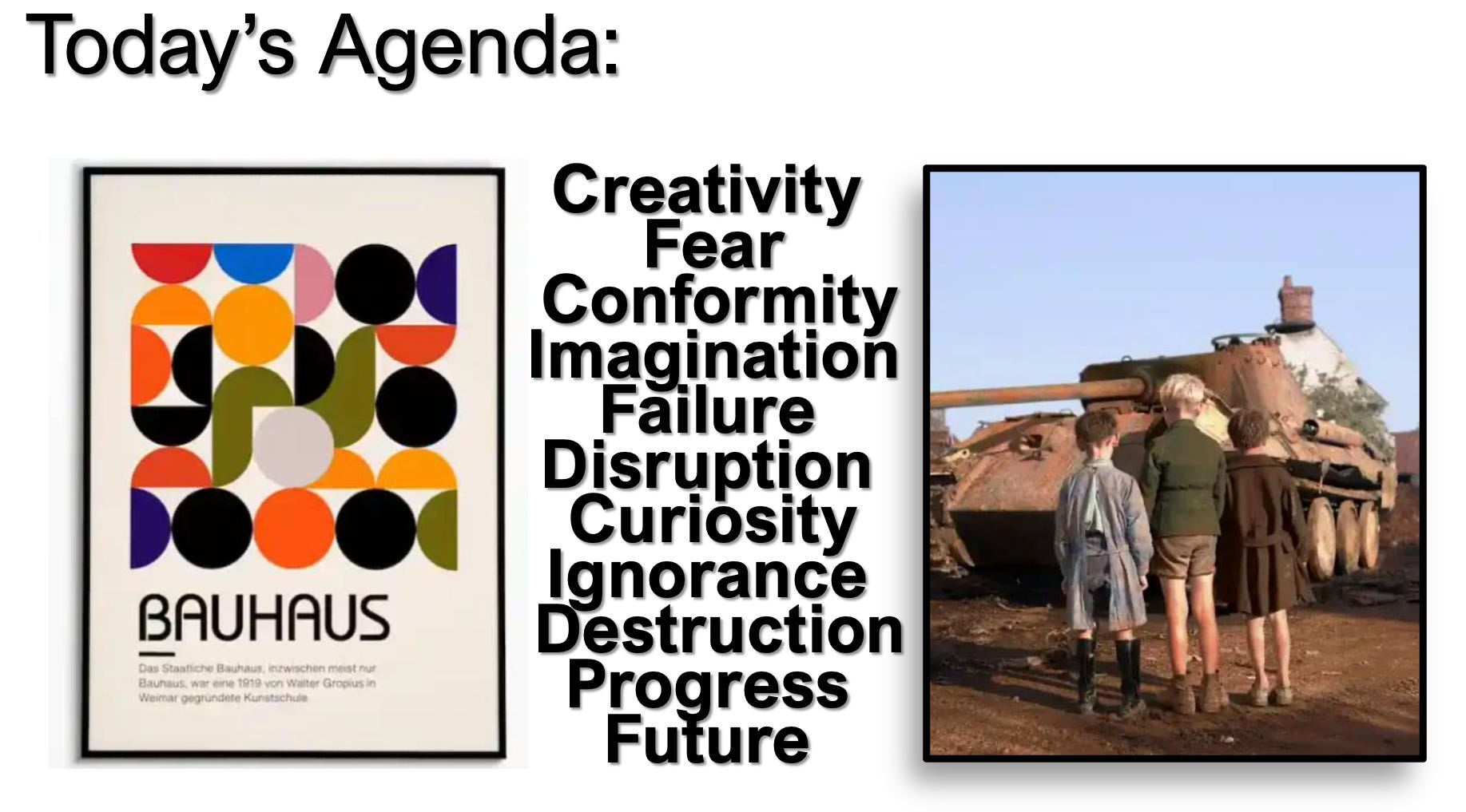
Here, I frame the broad topics with two important images. First, I talk about the list of words and ask the audience about which ones ‘pop’ out to them and why. I prefer when possible to immediately from the onset to engage with the audience and get them into a dialogue so there is more of a back and forth instead of a ‘sage on the stage’ scenario. This gets tricky with auditoriums and 300 war college students (looking at you, NDU) but we work with what we get. Depending on the audience (military or academic/civilian), I ask which of these words matter most for war and security. Next, I talk about the two images. On the left is a famous Bauhaus print- this is a post-WW1 German art movement that began as a school for disillusioned, disgruntled German ex-officers and enlisted that were bitter after the First World War. They began a wonderfully unusual and highly unorthodox, provocative art school that became a serious, influential art movement in post-war Germany. Ironically, the Nazis would shut the school down after they seized control of the government, due to fears that the Bauhaus group was sympathetic to communist ideals and other issues. However, despite the Bauhaus being shut down, the influence of their design and innovation spread throughout Germany and across the world, helping redefine design and aesthetics in the 1920s-1930s.
On the right, a colorized image of three German children gazing upon a ruined tank in post-war Germany. Again, this is a reference to how war-torn societies become fertile grounds for change, disruption, revolution, even radicalized ideas of all sorts and colors. If anything, military victory might just reinforce conventional, orthodox, and institutionalized concepts further… creating later vulnerabilities that might be even harder to shake. B. H. Liddell Hart (a famous British WW1 veteran and influential Interwar Period military thinker) once remarked in the Interwar Period, “the only thing harder than getting a new idea into the military’s head is getting an old one out.” Between these two images, I set the grand narrative about what we will be discussing- war, innovation, and change (hey- isn’t that part of the book title?)
Slide 3:
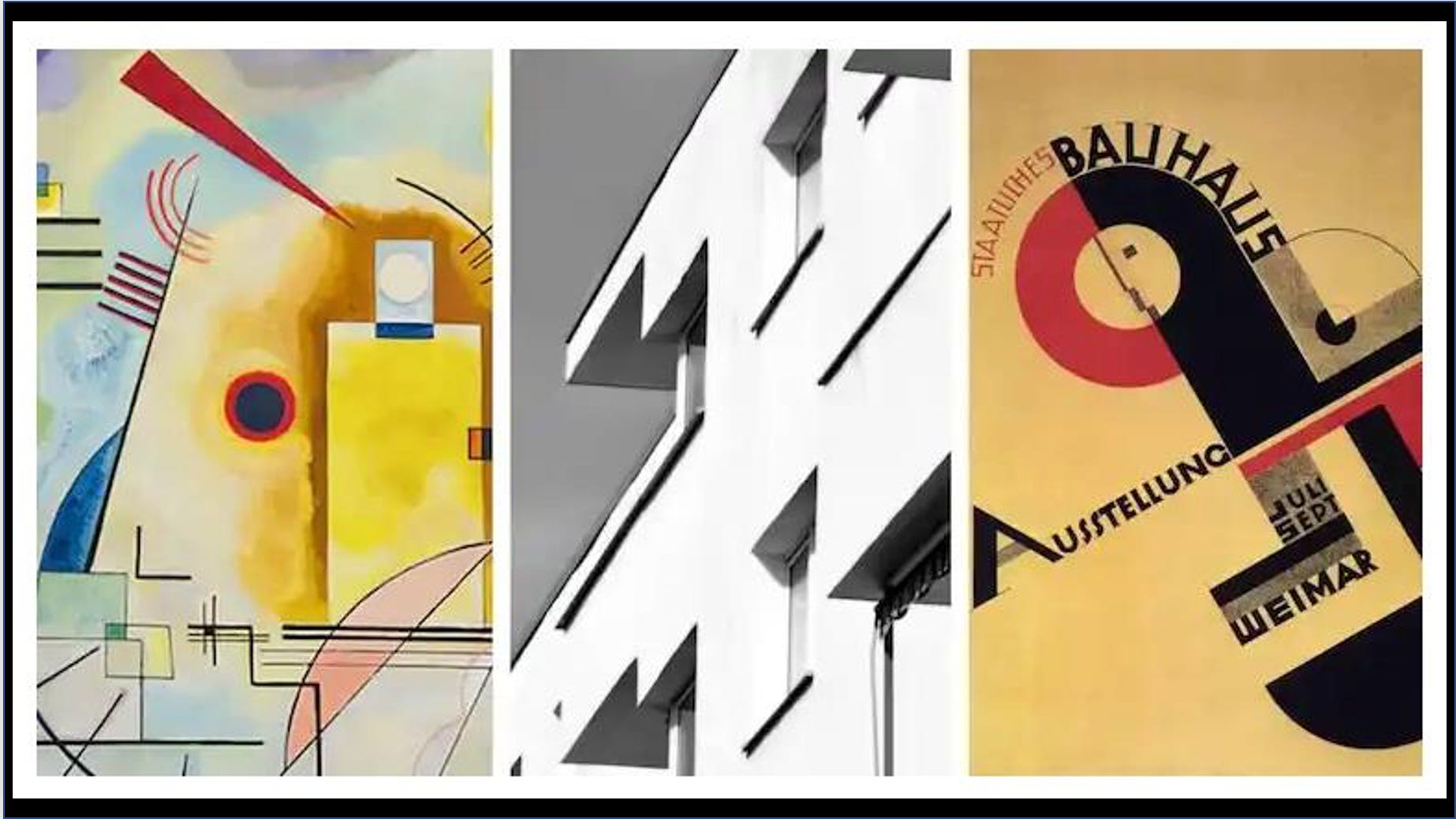
I will paste the slide notes here and this mostly comes right from my book. These are three images of Bauhaus design deliverables made in the 1920s or early 1930s before the Third Reich shuttered the school:
The first modern design educational enterprise started in Germany in 1919 and was called the Staatliches Bauhaus, more commonly referred to as ‘Bauhaus’ or ‘school of building’ when translated from German. Originally an eclectic home for combining industrialized crafts with new styles and ideas from the fine arts disciplines, it would blossom into a powerful industrial design movement that included architecture, graphic design, advertising, interior design and above all, an intellectual growth for creative design expression. There are some examples of earlier industrial design education, yet the Bauhaus was arguably the first formally structured and implemented as a modern design school with a recognizable form of knowledge, practice, education and collective vision.
Of the many German military officers that survived the war only to return to a broken society, Walter Gropius would in his own intellectual soul-searching develop the vision to establish this radical and disruptive school of commercial design. Gropius wrote about his war experiences and a desire to: “start building [his] life anew;” that in the chaos that was the interwar period Germany, he hoped “that through a new art, a new order could be created. Gropius called for a unification of the arts.”
Not only would war bring about the conditions to create the first modern design school that featured theory, education, experimentation, and a cohesive ethos, but political, social and military fallout as a reaction World War I would also later cause the closure of it. Bauhaus occupied the interwar period of 1919-1938 almost exactly, inhabiting a difficult and increasingly tense position in German society as a disruptive, counterculture and source of innovation as well as controversy in an unstable and chaotic period. The German Nazi regime in 1933 forced the closure of the Bauhaus school due to an association of the school with communist intellectual thoughts as well as the disruptive, critical and influential influence of the Bauhaus community of practice upon European society.
This sets the stage for the next slide where we talk about the overarching transformation Western societies were undergoing in the early 20th century (extending from the 19th)- industrialization and a migration of people to urban centers, farms to factories, individualized and tailored goods to mass-produced, generic or standardized designs, and larger institutionalized structures for societies, organizations, and daily life.
Slide 4:
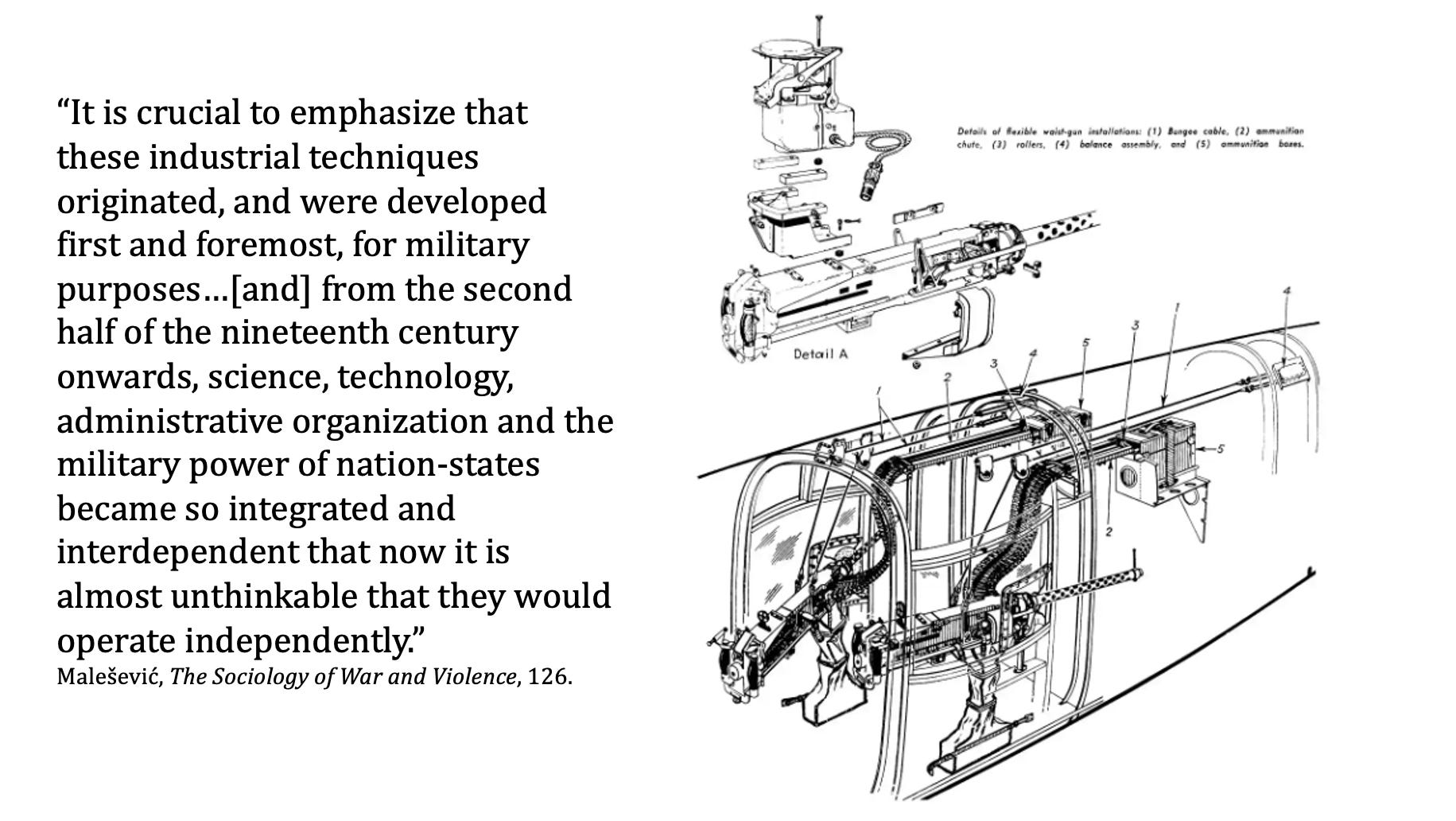
Design means many different things depending upon the person, the situation requiring a design application, as well as the various disciplines or fields that an organization is knowledgeable upon concerning the designs of their design! Bruce Archer, in attempting a ‘science of design’ primarily for architectural, industrial, and commercial design defined it with: “to make the plans and drawings necessary for the construction of” and “to fashion with artistic skill or decorative device.” Commercial designer Kees Dorst is more abstract, positing design as a process that dates back to prehumen ancestors and represents the urge “to consider a situation, imagine a better situation, and act to create that improved situation.” Buckminster Fuller offers that design can be “a weightless, metaphysical conception or a physical pattern…when we say there is a design, it indicates that an intellect has organized event into discrete and conceptual inter-patternings…the opposite of design is chaos.”
The notion that industry, commerce, and civilian academia is somehow divorced or independent of military (war, warfare, conflict, state-on-state organized violence) activities is a recent phenomenon. Perhaps it stems from social change after the Second World War, the Civil Rights Movement that overlapped with the Vietnam War and a societal rejection of the draft, or the long period of mostly peaceful (for the US) decades after the collapse of the Soviet Union in the early 1990s. Regardless of the reason, the issue I raise here is that ‘design thinking’ cannot be placed in some sterile laboratory environment where we might wipe off any residues we find obnoxious or repulsive. Commercial designers tend to roll their eyes at military organizations, or shudder to contemplate design outputs being used for organized violence and destruction. Militaries sniff at the idea that civilians could grasp or handle the problems they face on a battlefield, and tend to disregard anyone that has “never been shot at.” These broad stereotypes are real, but not all-encompassing. Many designers I work with have experienced both sides of this tension, and have many stories of such actions leading to misunderstanding and worse.
Slide 5:
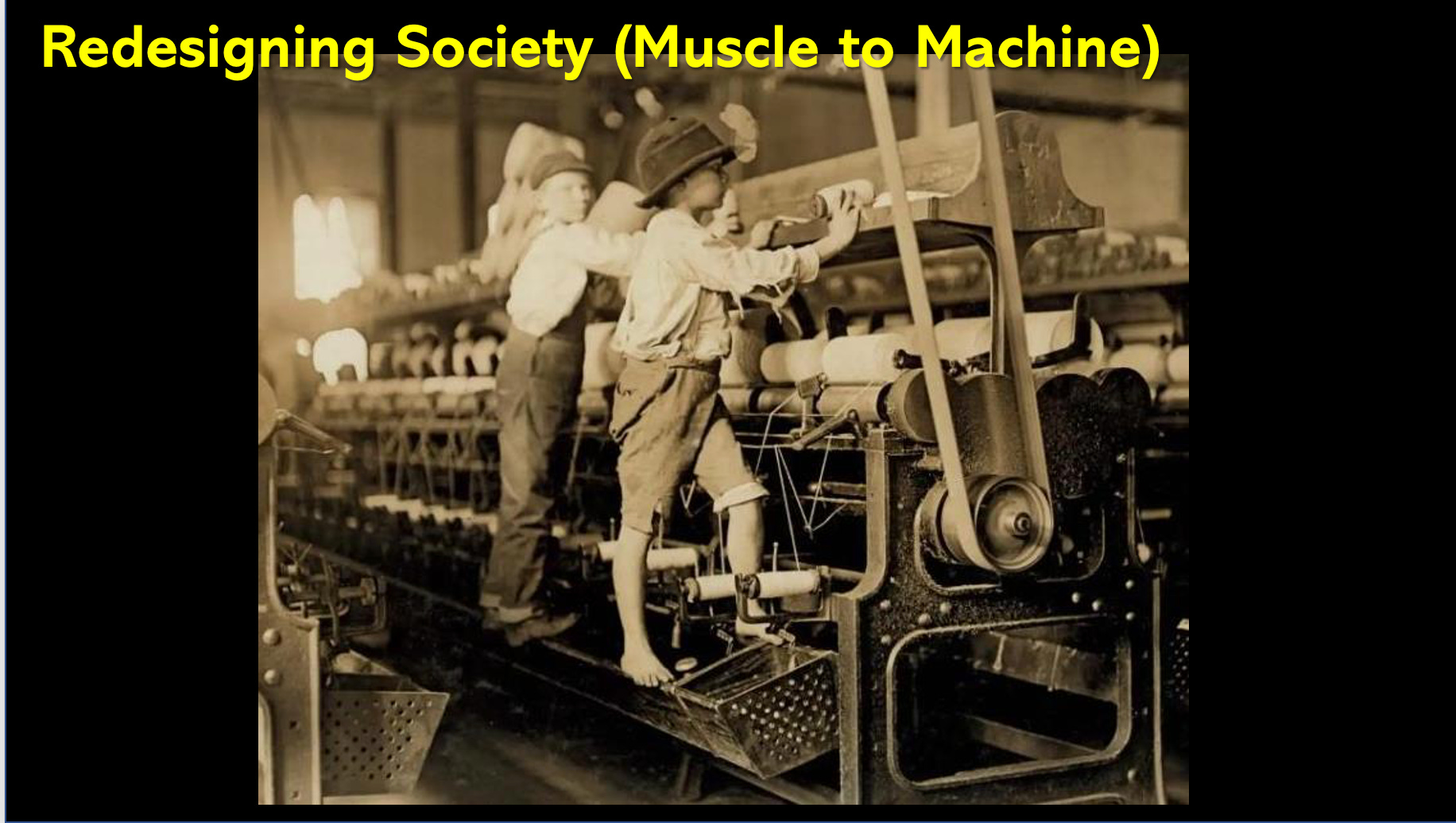
Leading with a provocative image to most of us today (except evil fashion designers wanting to kill the Prime Minister of Malaysia) would find shocking, I talk with the audience about why the Industrial Revolution was, well, revolutionary. It changed Western societies in significant ways. The image of young kids working seems outlandish, until you consider history. If these kids were in the 17th, or 18th, or 19th century, they likely would be doing similar hard labor on a farm. Schooling was for the elites and, when available, for the masses if the chores were done and it was not harvest time. Migration into urban centers meant that labor, even child labor, was valuable. The point of the image is to challenge our contemporary assumptions about what life was like in the early twentieth century for those societies that would drag the world into two World Wars and how things had changed from just a century earlier. Consider that trains and telegraphs forced humanity to develop time zones because prior to these 19th century technological developments, no one could travel fast enough to require time shifts!
The slide notes:
The Industrial Revolution ushered forth the modernization of many disciplines and fields, including artistry and earlier design efforts at a massive increase in scope and scale. This came with costs. A conservative window for when design in some modern, organized and recognized sense started coincides with early industrialization efforts in the seventeenth through eighteenth centuries. Artistry existed well before this, and design specialization first oriented toward products and mass production, whether for tools of commerce or tools of war. Yet it would not be until the twentieth century where we see the emergence of formal schools and design communities of practice complete with unique language, methods, culture, and philosophies on design. . This coincides with the rise of modern management theory, the raid growth of factories, urban sprawl, public education, and many significant social reforms where universal standards and formal regulations stimulated specialization and certification of who is recognized as a designer, and who is not. Victor Papanek framed this with: “the ultimate job of design is to transform man’s environment and tools, and by extension, man himself. Man has always tried to change himself and his surroundings, but only recently have science, technology, and mass production made this more nearly possible.”
For design fanatics, if you have not checked out Victor Papanek’s books on design, please do! His work from the 1970s is largely forgotten today; you can snag an old copy for a few dollars online and it is very much worth the investment.
Slide 6:
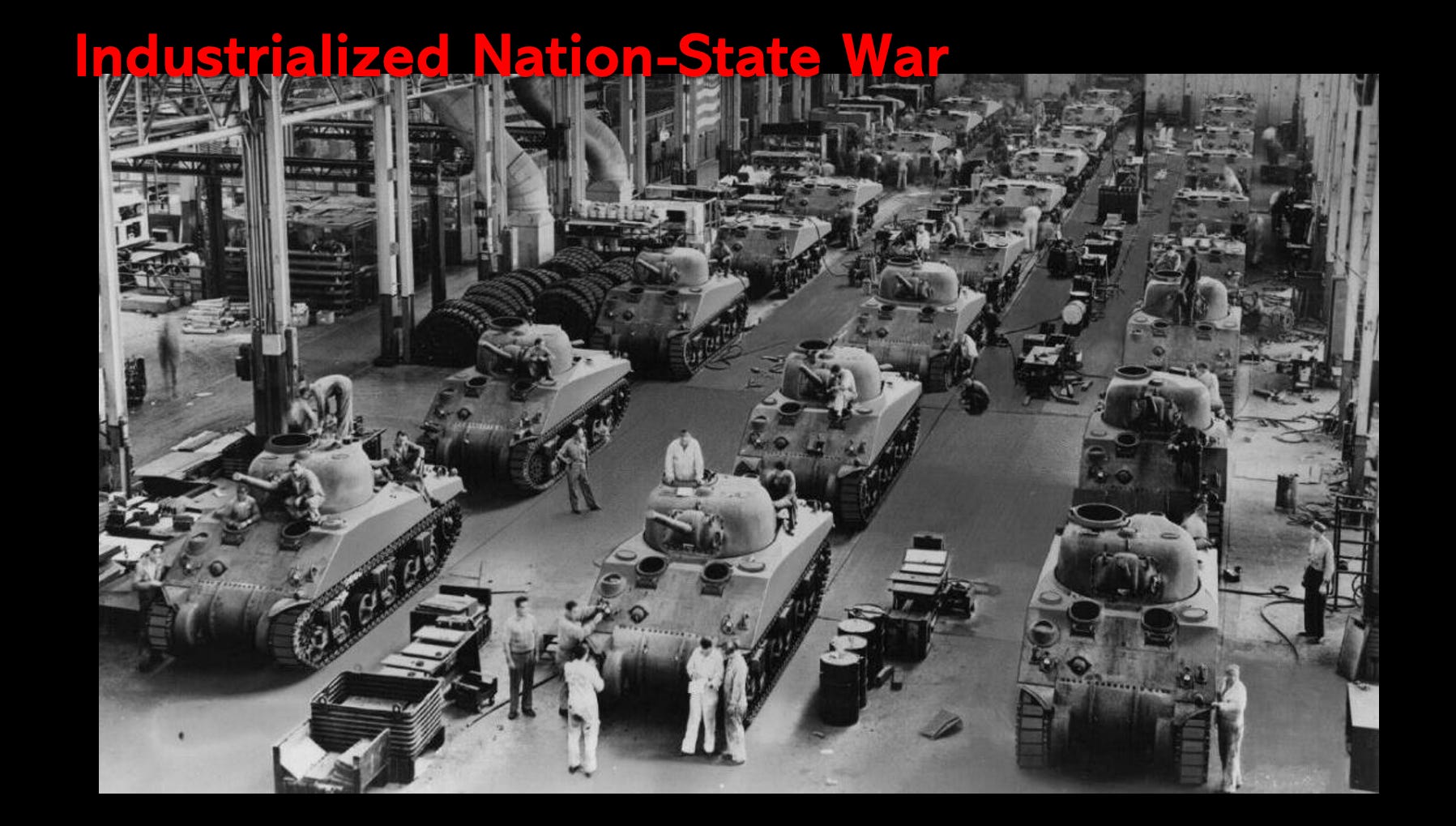
This slide gives us another fascinating image- the massive scale of the World War II effort. Slide notes:
Broadly speaking, the modern interpretation of ‘design’ developed largely within the twentieth century after multiple military organizations in World War II struggled with complexity and increasingly difficult challenges with scale, size, and emergent conditions that come with advanced industrialized societies. Earlier 18th and 19th century industrial design movements were necessary precursors, yet still largely wedded to earlier apprenticeship and ascientific or localized modes of professionalization. Over the last 300 years of rapid industrialization and technological advancement, design expanded from artisan or localized processes into formalized, modern enterprises, with new demands made utilizing technological, social and political developments. War would follow suit, with the myriad and sophisticated war plans of increasingly technological forces spanning multiple time zones and strategic objectives requiring new design cohesiveness.
Slide 7:
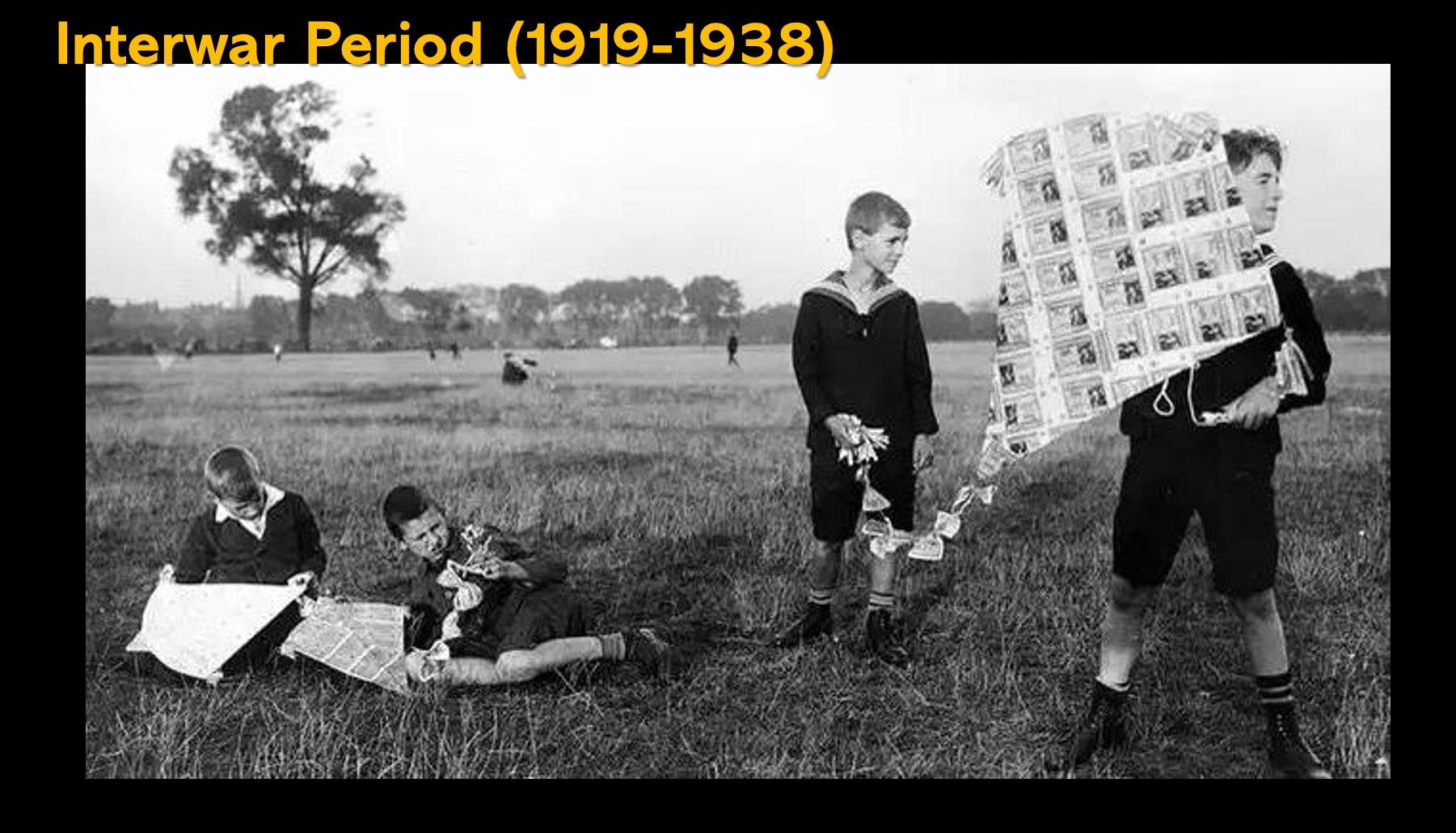
I use this slide to illustrate the disruption occurring in Germany in their post-war period of the 1920s-1930s. Here, German children make a kite with German currency of the period, which was practically worthless.
The Interwar Period between WW1 and WW2 had many significant developments that form what I posit are the most significant foundations for the modern design community of practice, the rise of formal design schools, the militarization of design, and the transformation of the modern defense industry via design into a total-war enterprise of Westphalian nation state power and survival.
It was in the Interwar Period that ‘design’ in a modern sense began. The Bauhaus School became a reality due to these societal pressures and disruptions due to conflict, war, devastation, suffering, and outrage.
Slide 8:
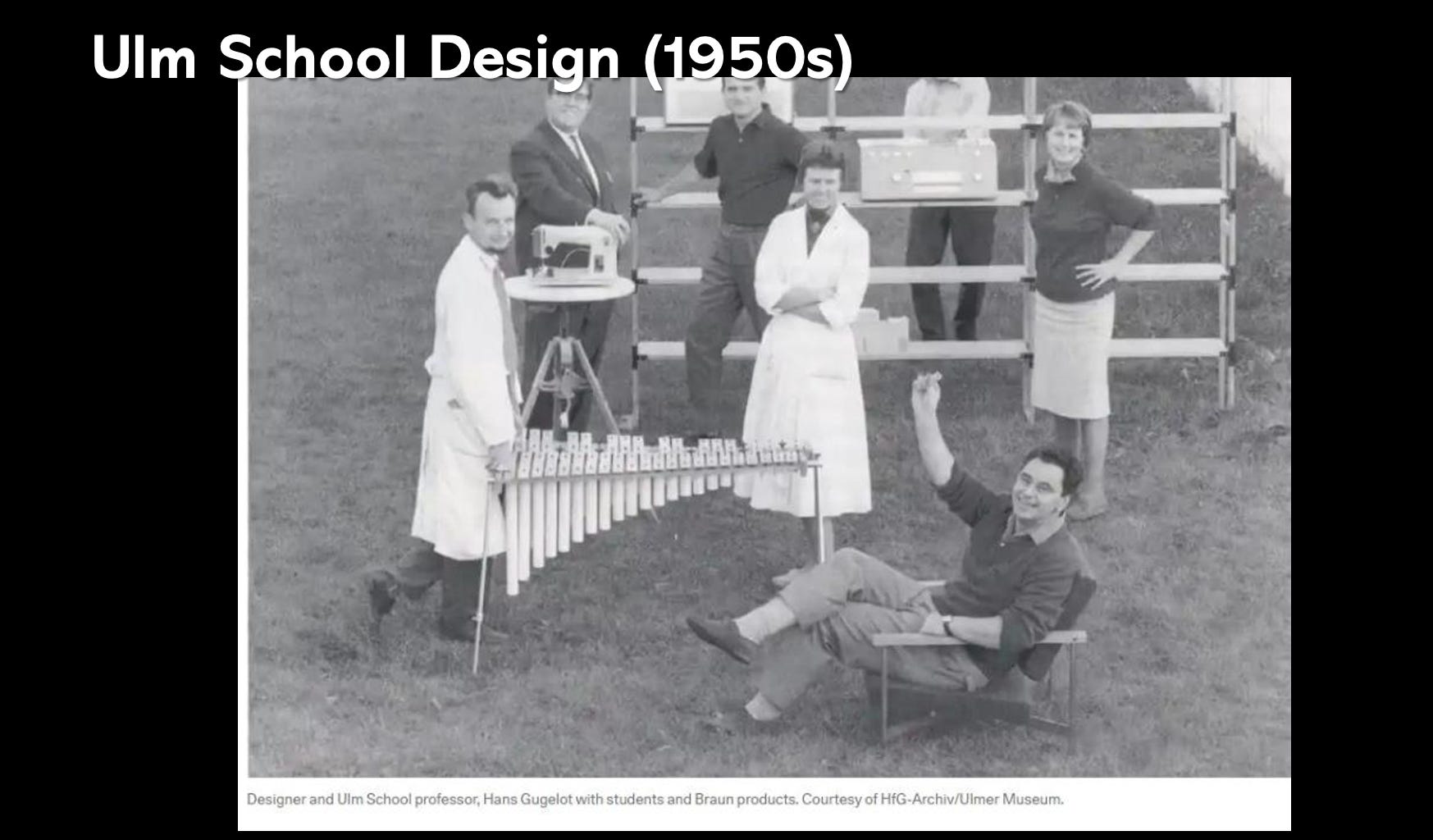
The Ulm School is a direct result of the earlier Bauhaus suppression and Germany losing a Second World War, entering into yet another period of disruption, frustration, and new Cold War tensions in the post-1945 atomic world.
Slide notes:
Despite the closure of the Bauhaus in 1933, the radical ideas concerning a modern exploration of design with art, multiple new theories, and the need to scale design education to a larger and more structured format would live beyond the shuttered schoolhouse. This Bauhaus movement would deeply influence subsequent commercial as well as military design developments, especially after 1945. This birth of modern design challenged societal norms, reframe belief systems and conceptual frameworks in a ripple effect spanning well beyond the reach of Nazi oppressors.
In 1953, Max Bill, Ingre Aicher-Scholl and Olt Aicher founded the Ulm School of Design or Hochschule für Gestaltung in West Germany, drawing inspiration from the earlier Bauhaus efforts. The Ulm School would only last a little over a decade but would extend the earlier Bauhaus design philosophy forward while moving into deeper theoretical and methodological explorations, liberated from the earlier oppressive Nazi regime and now beyond the grasp of Soviet oppression. Horst Rittel, a professor at the Ulm School, would subsequently emigrate to California to introduce the foundations of human-centered design thinking to the University of Berkeley and elsewhere. Rittel would help usher in the next major commercial design movement and scale it considerably in American academia through the 1960s and 1970s. His academic design work would, along with a handful of other design pioneers in the late 1950s and 1960s establish the foundational sources of modern design theory and practice.
It was in this second blast of design school thinking that modern design methodologies took hold, first in Germany and quickly exporting to essential locations in the United States, such as in California in elite schools.
Slide 9:
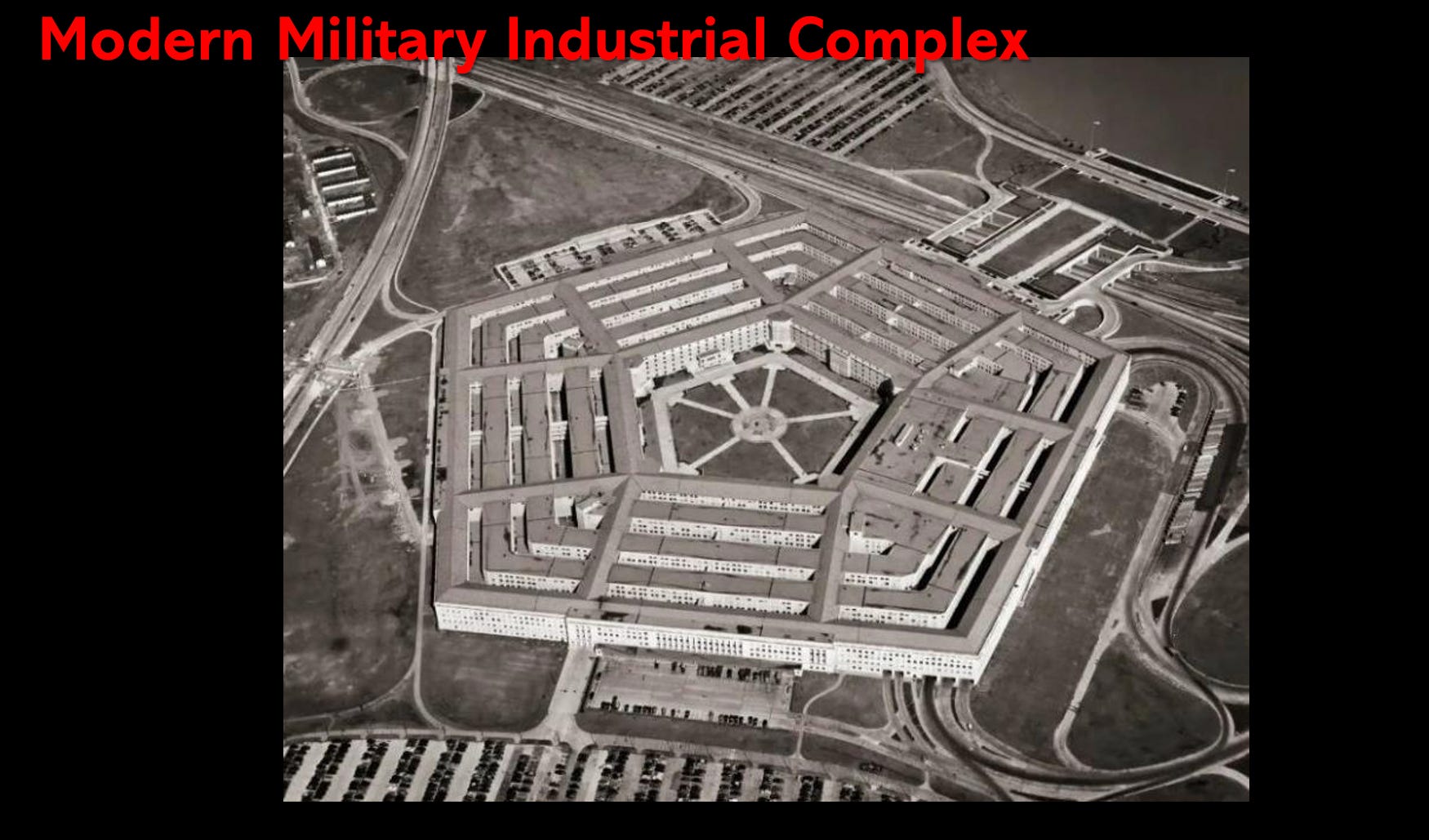
Slide notes:
All these commercial design educational developments would link back to the merging of the twentieth century’s industrialization, total-war application of organized violence, and the societal reactions to changing cultural, technological, and societal belief systems. Yet the direct linkages of organized violence and the role of creative design thinking would also become decoupled in this same period. Design movements after 1945 were unlike the interwar period movements in that Bauhaus practitioners drew heavily from their wartime experiences, while there is little evidence of post-World War II designers explicitly extending their wartime experiences into their design school identities, purposes or inspirations.
During the twentieth century and particularly after World War II, a generation of military professionals as well as those in the war-production industry would continue industrial design practice in expanding fields of design application well beyond the focus of organized violence, although external companies designing war products and experiences would grow into the ‘military industrial complex’ too. Ideas on strategy as well as large-scale planning would migrate from the military over to industry as thousands exited military service after 1945, with an expansion of military ideas surging in the 1950s in commercial settings for the first time. The exodus of wartime draftees back into civilian enterprise would inject military models, methods, and decision-making directly into commercial industry in the 1940s-1960s; concepts such as ‘strategy’ would enter businesses in formal, modern constructs that were matured in the wide-scale complex management of organized violence in the Second World War. Industry existed before both World Wars and accelerated after each of them, but the exchange of people, ideas, and behavior patterns would loop back and forth between commerce and war as one influenced the goals and desires (and designs) of the other. Design thinking became mainstream in architecture, products and services, advertising, and urban planning in the post-war world. Military veterans schooled in warfare would quickly fill the ranks of industrial, professional, and academic leadership roles, influencing the strategic and organizational directions of entire disciplines and sectors. Here, the design of new products and user experiences set in an industrialized, technology-centered economy would mature and expand the application of design thinking well into the twentieth century.
Slide 10:
I get tons of guff for presenting these philosophical terms in my lectures. Critics argue “you don’t need to use those off-putting, big words in… the average military officer does not need this stuff! Stick to the basics, keep it simple, stupid (KISS).” I usually reply and ask the critic to explain how they know they are right about this. Once they start, they usually shift into explaining a ‘why-related’ position, which I can then reply, “and now you are using ontology.” Ultimately, if we do not at least frame and acknowledge what ontology and epistemology are in a formal sense, I fear that any educational exchanges then devolve into rote memorization and training events- “do as I say, do not think about the why.” This creates loyal and non-reflective soldiers that will march off the cliff they are ordered toward, but unable to question whether walking off the cliff is a good move for the organization.

The slide notes:
I use the image of bees and flowers on the left for ‘ontology’ and ask the audience, “what is the prettiest flower of them all” Usually I get answers like tulips, roses, and the occasional wise ass answering ‘Corpse Flower’. Regardless of the answers, I then ask about why we as humans cultivate flowers into arrangements, and ask what sort of rituals flowers are used in. Weddings, funerals, romance, get-well gifts… we use flowers for nearly everything! Yet we also ‘know what flowers are appropriate for what activity’ within our culture. For instance, you should not gift red roses to your grieving neighbor after the death of their spouse, or bring funeral arrangements on your first date with a special love interest (unless you both happen to run funeral homes). Consider flower planting- we rip out weeds that have flowers to replace them with nicely trimmed rose bushes or beds of tulips. We have ‘rules’ on flowers because of our ontological assumptions on what flowers are and are not. Now consider bees. They do not use flowers for any of these reasons. The bees do not care if your yard is well maintained or a dog’s breakfast of weeds and overgrowth. Bees, in this metaphoric device (ignore whether bee cognition is sufficient or not) ontologically use quite different frameworks than we do on what flowers are and are not.
Ontology is the study of existence, and how humans conceive and perceive what we are, what the world consists of, and how reality is a continuum between purely objective and purely subjective extremes. Ontology is concerned with what is true or real, and the nature of reality which is why the earlier explanation of a social paradigm contained ‘what is/is not’ across each of the constructs for what, how and why. When military philosopher Clausewitz posits that “war is nothing but a duel on a larger scale…it is an act of force to compel our enemy to do our will,” he is ontologically stating that war occurs just as a violent fight between two dueling opponents. Ontologically, complex reality informs Clausewitz that war can be conceptualized and explained in a truthful manner by mentally associating a deadly contest of wills between duelists with that of nation states waging war. Ontology does not become any specific or tangible ‘thing’ in reality; rather ontology explains the order of things within reality and why the form and function of reality is as it is.
Epistemology is the study of knowledge and how humans create, maintain and order knowledge through different methods. Unlike ontology that links reality to conceptualized models within a human mind, epistemology begins within the mind and these mental events inform our perceptions that subsequently inform a separate reality. While ontology acts to help humans discover what ‘truths’ might exist in reality, epistemology enables humans to create their understanding of what ‘truth’ is and is not within the socially constructed framework they collectively maintain and curate. For example, people will weed their flower gardens so that certain plants are protected and nurtured, while weeds and undesirable vegetation is eliminated. We “know” what flowers are “pretty” or “valuable” or “proper for home décor”- and we also “know” about weeds and ugly things that must be removed. Yet insects and birds feed upon both without any such discrimination because humans will collectively distinguish epistemologically these constructs through culture and society. The epistemological constructs do not exist in reality and are entirely created within our minds, yet they deeply inform how we interact with reality.
I use an older military graphic for epistemology and you could literally use most any graphic from a military publication- they all indicate our epistemological (and ontological) assumptions on war. Here, we have war sliced up using geological models and metaphors (layers, like ogres and cake). If you put an Army officer and a Marine in the same room at a war college and asked them, “where might we find ‘centers of gravity’, the Army officer will firmly declare (epistemologically) that COGs exist only at the strategic and operational “levels” of war illustrated. The Marine will slap him on the back of the head and explain, “no, dummy- there are COGs from the strategic down to the tactical level!” They then can fight over who is right and who is wrong. Epistemologically, COGs are not real… you can declare you can identify and touch the person or thing you declare is the strategic enemy COG, but you are touching the leader and not the concept of an enemy strategic COG. The concept remains in our collective understanding of how the world works- our epistemology.
